Showing posts with label comics. Show all posts

Monday, 13 February 2023

More false morphologies

Mo Willems has an opposites book out, Opposites Attract, and the Children's Museum of Pittsburgh has a show about it, which has reminded me that there's an 'antonym blog' folder on my desktop with things I've not been posting here. 

So, for the sake of posting something, here are a couple more takes on a now-familiar kind of cartoon, where a series of letters that looks like a word within a word (but isn't a word within that word) is replaced by an opposite.  I need a name for these, so I can tag them all. Let's call them false-morphologies. Now that I've tagged them, you can find the others here


Thursday, 14 May 2020

plover/plunder

If you don't follow Moose Allain on Twitter, you should. Might be useful when I teach about how to (not) recognize morphemes.


Wednesday, 24 April 2019

Tuesday, 12 March 2019

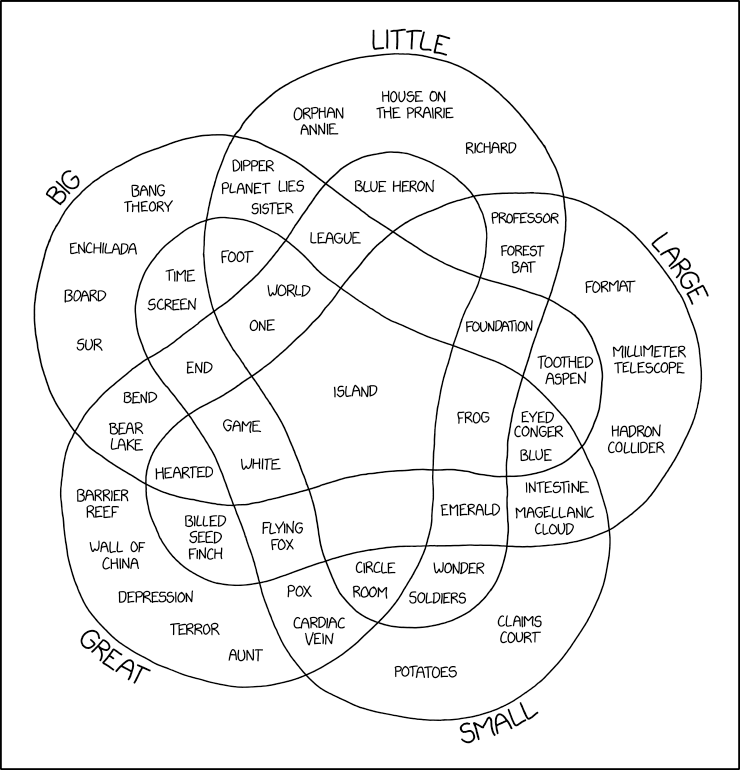
big little large small great

Every work on antonymy needs a big ol' section on why big/little are 'better' antonyms than large/little. I know, I've written more than one.

Too bad I didn't have xkcd's handy guide!


Friday, 7 December 2018

the blog opposite

Arnold Zwicky has recently written a couple of post relating to antonymy on his blog. Always worth reading AZ, whose own initials seem a bit oppositey.


11/21/18: One Big Happy analyses:
https://arnoldzwicky.org/2018/11/21/obh-analyses/

12/5/18: uncle-o-nym:
https://arnoldzwicky.org/2018/12/05/uncle-o-nym/

Friday, 20 April 2018

many kinds of 'happy'

One thing that always interests me as an antonymist is how a single positive term can have many different-meaning opposites. So, sweet can be the opposite of sour, salty or bitter, depending on context, and happy is opposed to sad, angry, and possibly others. It reminds me of the Anna Karenina principle: "Happy families are all alike; every unhappy family is unhappy in its own way."

Anyhow, I like T-Rex's attention to the different kinds of positive emotion (click to enlarge):

Saturday, 23 December 2017

Saturday, 18 November 2017

Dinosaur Comics does my dissertation

So, as part of my PhD research I asked people questions like "what's the opposite of grass?" and things like that.

So, basically, Dinosaur Comics is replicating my doctoral research--and comes to pretty much the same conclusion. (click to enlarge)


Monday, 21 November 2016

Dinosaur comics on opposites

Ryan North, author of Dinosaur Comics, likes a lexical relation. I don't want to steal his comics, so forgive the links-only approach. I'll do a little summary:

Saturday, 27 February 2016

Scrambled pairings

Today's xkcd:


Mouseover text: "The Romeo and Butt-Head film actually got two thumbs up from Siskel and Oates."


I'd like to do an experiment where half the people read it with the left side covered (and have to complete the phrase) and half do it with the right side covered and try to get the 'normal' pairings on which the comic is based. I assume accuracy and speed would be harder with the left side covered...


Sunday, 14 February 2016

Happy Valentine's Day

This showed up in my Facebook feed this morning:


Apparently you can buy it as a print here.

At different points in my life, I've believed (a) you can only really hate what you've really loved, and (b) you can never really hate what you've really loved.  The first option was teenage melodrama. I'm sticking with (b).

Wednesday, 20 January 2016

opposites in love


This picture came to me from the Tiger Lillies' Facebook page (thanks to @mertevenk for identifying the source, Construction Paper and Tears). Here, the opposites are connected by love. 

This reminded me of the epigram to the first chapter of my 2003 book, where another pair of opposites live in the same house. Is that because they are in love, too? [Click on the excerpt to make it bigger, should you need to.]


Tuesday, 27 October 2015

antonyms in sound symbolism study

I was interested in the use of antonyms in a study exploring sound symbolism. To quote a Quartz article about it:
Kaitlyn Bankieris, a cognitive scientist from the University of Rochester, and Julia Simner, a psychologist and leader in the field of synesthesia, showed participants 400 adjectives from 10 languages they didn’t speak: Albanian, Dutch, Gujarati, Indonesian, Korean, Mandarin, Romanian, Tamil, Turkish, and Yoruba. The words were broken up into categories by meaning: big/small, bright/dark, up/down, or loud/quiet. Participants heard the words spoken aloud and guessed their meanings.
Synaesthetes were better at the task than others, but overall both syntaesthetic and non-synaesthetic could guess the words at a better-than-chance rate, presumably because the words with 'small' meanings restrict the vocal space more and the ones with 'large' meanings open the vocal tract more--this is known as sound symbolism. Another article about the article can be found at Scientific American.

One assumes that if they asked people if the word meant 'small' or 'bright', they'd be back to chance. It's being on one or the other side of a scale that leads people to the right answer.